I almost treated Jiuzhaigou like a normal sightseeing park: buy a ticket, walk in, wander from lake to lake. That would have been a mistake. Jiuzhaigou is a 60-kilometer Y-shaped valley system at 2,000–3,100 meters, with a mandatory real-name reservation, a 14:00 entry cutoff, and sightseeing buses dispatched by a control center rather than by the visitor. The first useful decision is not “which lake is prettiest?” It is “which train, which ticket slot, and which side of the Y do I start on?”
I wrote this guide as a planning notebook rather than a list of superlatives. The prices and rules below reflect the 2026–2027 off-season, which began on 16 November 2026 and runs to 31 March 2027. Peak-season figures are included too, because most first-time visitors still aim for autumn color. I have checked the key numbers against the Jiuzhaigou management bureau’s notices, the Sichuan culture and tourism department, and the current 12306 rail timetable. Prices and closures can change, so reconfirm the day before you travel.
My short answer: take an early high-speed train from Chengdu East to Huanglong-Jiuzhai Station, sleep at the park gate in Zhangzha, enter Jiuzhaigou once at opening time, and give the park a full day. Do not try to see Jiuzhaigou as a day trip from Chengdu. In winter, the ticket is cheap and the crowds are thin, but the color forest is gone and some high-altitude boardwalks are closed.
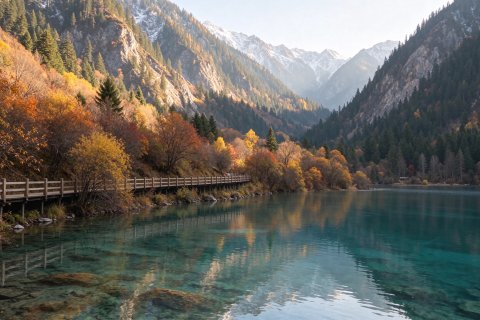
- Best for autumn color: roughly 20 October–5 November, with the exact peak moving by a week or so each year.
- Best for quiet and value: 16 November–31 March, when the combined ticket drops to CNY 160.
- Minimum sensible stay: two nights at the gate for one full park day; three nights if you want Huanglong or a slower second morning.
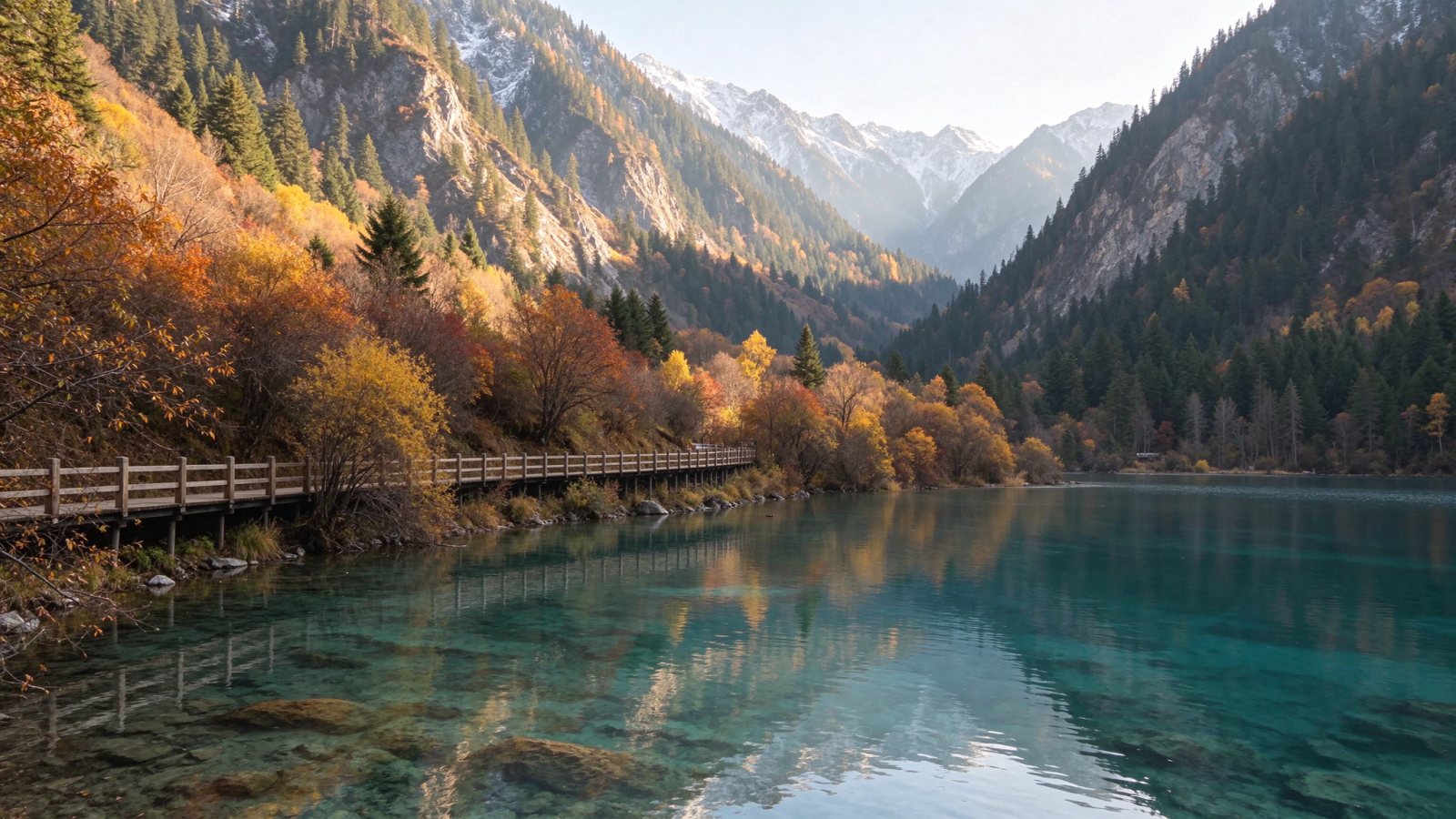
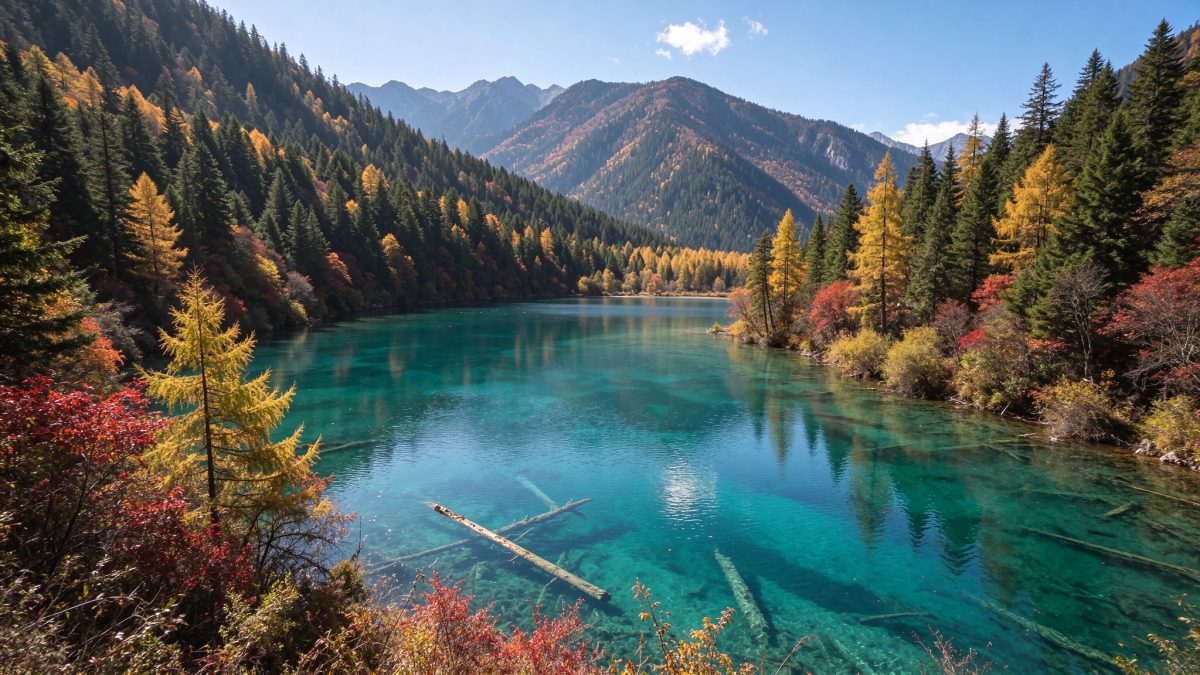
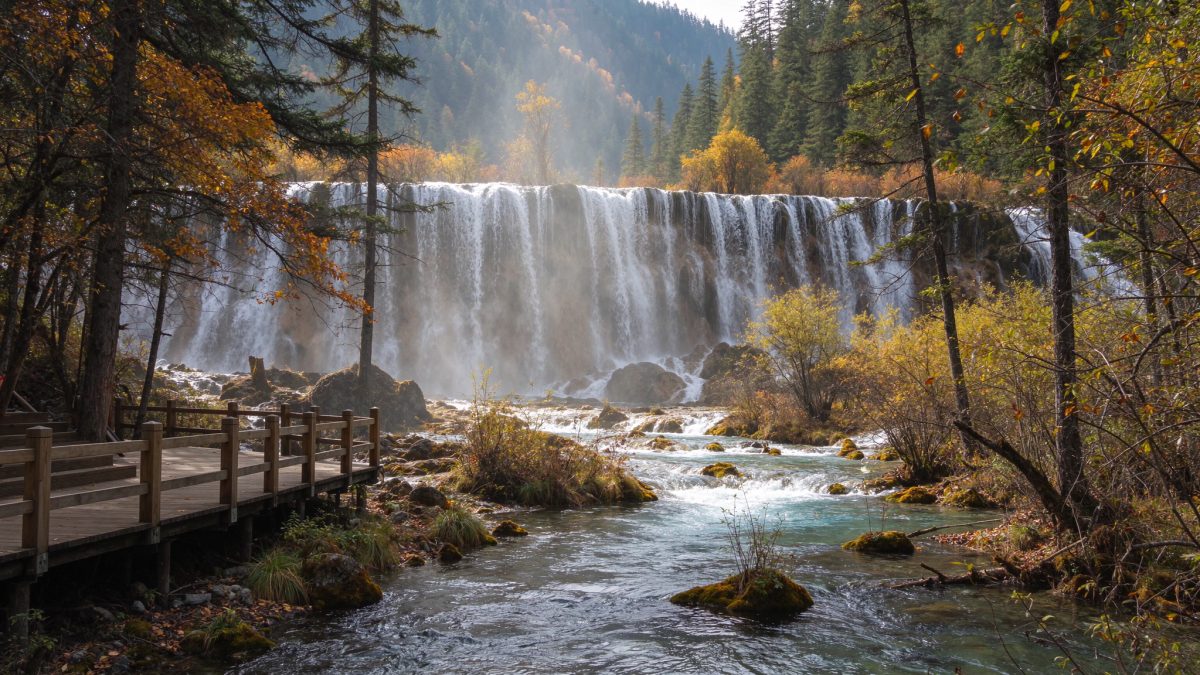
- Do not miss: Five-Flower Lake, Pearl Shoal Waterfall, Changhai Lake, Five-Color Pond, Nuorilang Waterfall and the Shuzheng Lakes.
The one thing I got wrong about Jiuzhaigou
I assumed the hard part would be the scenery. In practice, the scenery is almost too easy: every few minutes the bus stops and another impossible shade of turquoise appears. The hard part is sequencing. Jiuzhaigou has three valleys:
- Rize Valley — the right arm of the Y, holding the densest concentration of highlights: Arrow Bamboo Lake, Panda Lake, Five-Flower Lake, Pearl Shoal and Mirror Lake.
- Zechawa Valley — the left arm, ending at Changhai Lake and the small, saturated Five-Color Pond.
- Shuzheng Valley — the central trunk from Nuorilang down to the gate, with Nuorilang Waterfall, Rhinoceros Lake, Tiger Lake, the Shuzheng Lakes and Reed Lake.
The buses do not let you design a private route from the gate. Staff dispatch vehicles to the upper end of one valley or the other depending on crowd flow. My plan therefore has to be flexible: ride to whichever upper valley you are sent to first, work downhill, transfer at Nuorilang, then finish with the central valley on the way out. That is the difference between a calm day and a day spent crossing the park twice.
Quick answers before you book
| Question | Answer for 2026–27 |
|---|---|
| Where is Jiuzhaigou? | Jiuzhaigou County, Aba Tibetan and Qiang Autonomous Prefecture, northern Sichuan, about 420 km by road from Chengdu. |
| How do most travelers arrive? | High-speed train from Chengdu East to Huanglong-Jiuzhai Station, then a shuttle about 93 km and 2 hours to the park gate. |
| Do I need to book ahead? | Yes. Real-name online reservation is required and there is no on-site ticket window. Peak dates sell out. |
| Can I enter after 14:00? | No. Last entry is 14:00 every day; the park closes at 18:00. |
| Can I stay inside the park? | No. The rule is “visit inside, sleep outside”; all accommodation is in Zhangzha or nearby villages. |
| Is one day enough? | For the headline sights, yes — 6–8 hours on the bus-and-boardwalk circuit. For photography or a relaxed pace, two park days are better. |
When to go: the trade-offs I would weigh
Jiuzhaigou’s “best time” depends on which version of the park you want. The autumn postcard — gold larch, red maple, deep blue water — is real, but it is also the most expensive and crowded version. Winter is quieter and cheaper, but the high valleys lose their color and some routes close for ecological rotation.
| Season | What you get | What you give up |
|---|---|---|
| Late September–early November | The classic color forest; crisp air; the best chance of reflections. | Highest prices, heavy domestic demand and a real risk of tickets selling out. |
| 16 November–31 March | CNY 160 combined ticket, thinner crowds, snow on the peaks and a more meditative park. | Colour is mostly gone; Primeval Forest and some high-altitude boardwalks usually close; ice and cold. |
| April–June | Spring green, strong waterfall flow, comfortable walking weather. | CNY 280 peak ticket returns from 1 April; weekends and holidays can still be busy. |
| July–August | Full lakes, lush forest, long daylight. | Rain, landslides on the approach road, holiday crowds and the fastest-selling tickets. |
My pick: if this is a once-in-a-lifetime trip and you care about photography, aim for late October and accept the cost. If you care more about space, value and snow scenery, go after 16 November. I would not plan a first visit around a specific “peak color day” unless I had at least three flexible dates.
Tickets and reservations in 2026–27
The ticket is two separate products: entrance and the internal sightseeing bus. In practice you need both. The valley roads alone are more than 60 km, and walking between the three valleys is not a realistic one-day plan.
| Season | Entrance | Sightseeing bus | Total per adult | Daily cap |
|---|---|---|---|---|
| Peak: 1 April–15 November | CNY 190 | CNY 90 | CNY 280 | 41,000 |
| Off-season: 16 November–31 March | CNY 80 | CNY 80 | CNY 160 | 23,000 |
Optional insurance is CNY 10 and should not be confused with the ticket. Children under 6 or under 1.2 m generally receive free entrance and bus; children aged 7–18 and full-time students can receive half-price entrance, while the bus rules vary. Seniors aged 65 and over normally receive free entrance but still pay for the bus. Bring the passport or ID used for the booking — the ticket is tied to the person, not just the date.
How I would book
- Use an official channel. The Jiuzhaigou Tourism Official Platform mini-program (WeChat or Alipay) and the Aba Tourism Network are the core channels. Ticket enquiries: 0837-7769999; park information: 0837-7739753.
- Book 7–14 days ahead in peak season. For July, August, National Day and the late-October color window, book as soon as your date opens. If your date is sold out, use the official waitlist rather than buying from a station tout.
- Use the passport channel if you are a foreign visitor. The Chinese-language mini-program is built around mainland ID registration and passport handling can be inconsistent. Book only through a channel that explicitly accepts passports, and keep the confirmation and collection instructions. Do not assume the gate will sell you a same-day ticket.
- Arrive early, not at 13:30. The 14:00 cutoff is an entry deadline, not a suggestion. A 14:00 arrival leaves no useful time for the upper valleys.
Off-season reality check: from 16 November to 31 March the park operates 08:30–18:00, with entry until 14:00. It also carries out seasonal ecological rotation, closing some scenic spots and boardwalks. In recent winters this has included Primeval Forest, Grass Lake and Swan Lake, plus sections around Changhai and the Rize Valley trail network. The exact list can change with snow and wildlife protection, so check the park map at the gate and the official notice the day before.
How I would get there from Chengdu
The high-speed rail link changed the trip. What used to be a seven- or eight-hour mountain drive is now a train ride of about 1 hour 39 minutes at best, followed by a two-hour shuttle. The catch is that the station is not at the park.
Step 1: Chengdu East → Huanglong-Jiuzhai Station
Book to Huanglong-Jiuzhai Station, not a similarly named stop. Some trains continue to Huangshengguan or Songpan; check the station list rather than the final destination shown on the train. Most services take 2–2.5 hours; second class is around CNY 141 and first class around CNY 225. In peak periods there can be roughly 30 services a day. Tickets normally open about 15 days ahead on 12306, which supports passport registration.
Take the earliest train you can tolerate. A departure around 06:30–07:00 gets you to the station around 09:00, into a shuttle, and to Zhangzha around lunchtime. A 10:00 departure can write off the afternoon.
Step 2: Huanglong-Jiuzhai Station → Zhangzha / the park gate
The station sits at about 2,977 m. The road to Jiuzhaigou is about 93 km and usually takes around two hours, more in snow or traffic. Shuttles are timed around train arrivals and generally run from about 06:00 to 23:00. Fares vary by operator and drop-off point — plan for roughly CNY 38–56, with CNY 51 being the most commonly quoted price. Some services can be booked about five days ahead in a mini-program; others sell at the visitor center outside the station.
Two practical details make the transfer much easier. First, save your hotel’s name and address in Chinese characters and show them to the driver or steward. Second, choose the drop-off nearest your hotel; the gate area and the main hotel clusters are common stops, but operators use different names. If you are staying in Pengfeng Village, confirm with the hotel which stop is closest before you board.
The alternatives, honestly
| Option | Time from Chengdu | Indicative cost | My verdict |
|---|---|---|---|
| High-speed train + shuttle | 3.5–4.5 hours door to door | About CNY 180–200 before park ticket | Best all-round choice; most reliable in winter. |
| Fly to Jiuzhai Huanglong Airport | About 1 hour flight + 2 hours road | Highly variable; often CNY 500+ | Only if the flight is cheap and on time. Weather delays are common, and there is no dependable fixed airport shuttle. |
| Direct long-distance bus | About 8 hours | About CNY 168–220 | Budget option, but a long mountain drive and more exposed to landslides and traffic. |
| Private car / package | 7–8 hours by road | Quoted per vehicle | Good for families or combining Huanglong, but not a time-saver from Chengdu. |
Do not book a same-day return. The park’s last entry is 14:00 and the visit takes most of a day. Even if the trains line up perfectly, a Chengdu–Jiuzhaigou–Chengdu day trip leaves you rushing the two best valleys. Sleep at the gate.
Where I would stay — and where I would not
The park operates a strict “visit inside, sleep outside” policy. There are no hotels or guesthouses inside the valley. The best base is Zhangzha Town, the strip of hotels and guesthouses around the park gate.
- Gate area: the most convenient choice. Some hotels are a 10–20 minute walk from the entrance; others are a short taxi ride. This is where I would stay for a first visit.
- Pengfeng Village: quieter, with more guesthouse-style accommodation and mountain views. It is a short drive from the gate, so confirm that your host offers a morning drop-off.
- Jiuzhaigou County town: cheaper and more local, but 40–60 minutes from the gate. It makes an 08:30 entry stressful and adds two unnecessary transfers.
I would book two nights at the gate for one full park day: arrive the afternoon before, sleep, enter at opening, and leave the following morning. If you want a second park day or a side trip to Huanglong, add a third night. In late October, book early; the good gate-area rooms are the first to go.
The one-day route I would follow
This is the route I would give a friend who has one day and wants the essential Jiuzhaigou without sprinting. It assumes peak-season opening near 08:00, or 08:30 in the off-season. In winter, skip the closed upper section and start Rize Valley at Arrow Bamboo Lake.
| Time | Where | What I would do |
|---|---|---|
| 08:00–08:45 | Gate → upper valley | Clear entry, board the dispatched bus, ride to the top of Rize or Zechawa Valley. Sit on the left for Shuzheng/Zechawa views, right for Rize. |
| 08:45–11:30 | Rize Valley | Arrow Bamboo Lake (30 min) → Panda Lake (20 min) → Five-Flower Lake (40–50 min) → Pearl Shoal and Pearl Shoal Waterfall (40 min) → short walk or bus to Mirror Lake (15 min). |
| 11:30–12:30 | Nuorilang Center | Transfer hub and the only substantial dining area inside the park. Eat, refill hot water, and reset before the left arm. |
| 12:30–14:30 | Zechawa Valley | Bus to Changhai Lake (40 min). Walk to Five-Color Pond if the boardwalk is open (30 min), then bus back to Nuorilang (20 min). |
| 14:30–17:00 | Shuzheng Valley | Nuorilang Waterfall (30 min) → Rhinoceros Lake, Tiger Lake and Shuzheng Lakes (40 min) → ride or walk the lower valley past Reed Lake and Bonsai Shoal. |
| 17:00–17:45 | Gate | Exit, collect luggage, and eat dinner in Zhangzha. Do not schedule a train for the same evening unless it leaves very late. |
If the bus drops you at Changhai first, reverse the left and right arms: do Changhai and Five-Color Pond, return to Nuorilang, then work down Rize Valley, and finish with Shuzheng. The principle is the same: one upper valley, lunch at Nuorilang, the other upper valley, then the central valley on the way out.
What I would not do: try to walk the entire Y. The boardwalks are beautiful but the distances are long, the altitude is real, and the bus is part of the experience rather than a failure. I would also avoid scheduling Five-Flower Lake at midday on a tight timetable; it deserves more than a photo stop.
A slower two- or three-night plan
Two nights, one park day
- Day 1: Early train from Chengdu, shuttle to Zhangzha, check in, walk the gate area, eat yak hotpot, sleep early.
- Day 2: Full park day using the route above. Dinner in Zhangzha; do not rush to the station.
- Day 3: Breakfast, shuttle back to Huanglong-Jiuzhai Station, train to Chengdu or onward to Huanglong.
Three nights, park plus Huanglong
Use the same first two days, then add a day for Huanglong National Park or a slow morning around Pengfeng. Huanglong is higher and its shuttle and cableway have their own seasonal schedule; check before committing. Do not treat Huanglong as a quick add-on after a full Jiuzhaigou day — both parks involve altitude and walking.
What I would skip, and what I would do twice
Do twice: Five-Flower Lake and the walk from Pearl Shoal to Mirror Lake. The light changes, the crowds move, and the water looks different ten minutes later. Changhai is worth the full 40 minutes, not a quick snapshot.
Skip or shorten: the souvenir stalls at the gate, the “shortcut” offers from touts at the station, and any itinerary that promises Jiuzhaigou, Huanglong and Chengdu in one day. I would also skip a second park day in winter unless the snow and ice are the point; the closures make it less rewarding than a summer or autumn visit.
Food, altitude, weather and rules
What to eat
Inside the park, Nuorilang Center is the practical lunch stop; expect simple buffet or boxed meals and higher prices. I would carry nuts, chocolate, bread and a thermos, and refill hot water at Nuorilang. Outside the gate, Zhangzha does the warming food well: yak meat hot pot, Tibetan noodles, butter tea, highland barley cakes and locally farmed mushrooms. If you are sensitive to spice, ask for “微辣” or “不要辣”.
Altitude
The gate is around 2,000 m, Five-Flower Lake around 2,470 m and Changhai around 3,101 m. This is not Everest, but it is enough to make rushing feel bad. I would avoid alcohol on the first night, drink water steadily rather than in huge gulps, walk slowly on the Changhai boardwalk, and keep a small oxygen can in the daypack for anyone who has heart or lung concerns. Children and older travelers should set the pace, not follow it.
Weather and what I would pack
- Layers: base layer, fleece or light down, windproof outer shell.
- Non-slip shoes; in winter, add compact crampons. The boardwalks ice up before the roads do.
- Sunscreen, sunglasses and lip balm — the altitude makes the sun stronger than the temperature suggests.
- Power bank, because cold drains phone batteries; a light rain cover; a small daypack.
- Passport/ID, booking confirmation, hotel name in Chinese, and some cash alongside WeChat Pay or Alipay.
Rules I would take seriously
- No accommodation inside the park; no overnight stays.
- No drones, no pets, no swimming, no stepping into the lakes or travertine shoals.
- No smoking except at Nuorilang Center; the park is a high-fire-risk forest area.
- Do not feed wildlife or release animals; stay on the boardwalk and carry your rubbish out.
- The ticket is date- and identity-specific. Do not buy a “transferable” ticket from a reseller.
What it costs
For one person travelling from Chengdu, one park day and one night at the gate, I would budget roughly CNY 650–1,000 before shopping, based on:
- Train: about CNY 141 each way, second class.
- Station shuttle: about CNY 51 each way, with a range of 38–56.
- Park ticket and bus in the off-season: CNY 160.
- Mid-range gate-area hotel: CNY 250–600 per night, higher in late October.
- Meals and snacks: CNY 100–200 per day.
- Local taxis and contingency: CNY 50–100.
In peak season, add CNY 120 to the park ticket and expect hotel prices to rise sharply around the color-forest window. The train fare is the least volatile part of the budget.
FAQ
Can I visit Jiuzhaigou as a day trip from Chengdu?
Not comfortably. The train plus shuttle is 3.5–4.5 hours in each direction, and the park stops admitting visitors at 14:00. A day trip means seeing one valley in a rush. Stay at the gate.
Do I need a tour guide?
No. The park’s shuttle system, signage and boardwalks are easy to use. You do need a pre-booked ticket and a clear plan for the Y-shaped route. A guide is most useful for foreign passport holders who need help with the reservation, or for families who want someone else to manage the transfers.
Is the sightseeing bus optional?
You can buy the entrance ticket without the bus, but you should not. The valleys are spread over more than 60 km of road, and the bus is the only practical way to connect the upper viewpoints.
Can I stay inside Jiuzhaigou?
No. “Visit inside, sleep outside” is the rule. Every hotel and guesthouse is outside the gate, mostly in Zhangzha or Pengfeng.
Is November a good time?
Until about 5 November, yes for color. After 16 November, yes for price and quiet, but the color forest is mostly over and some high-altitude routes close. Decide which version you want before booking.
How many days do I need?
Two nights for one full park day; three nights if you want a slower pace or Huanglong. Four nights if you are combining both parks without rushing.
Will altitude sickness be a problem?
Most visitors notice only mild breathlessness. The risk rises if you rush, drink alcohol, or have an existing heart or lung condition. Walk slowly at Changhai, keep warm, and ask your doctor before travelling if you are unsure.
Can I use foreign credit cards?
Do not rely on them for small payments. WeChat Pay and Alipay are the norm; some foreign cards can be linked but not every merchant or mini-program accepts them. Carry a modest amount of cash and set up a payment app before you leave Chengdu.
What should I do if my ticket date is sold out?
Use the official waitlist in the Jiuzhaigou Tourism Official Platform mini-program, or change your date. Do not buy from touts at the station or from social-media “agents” who ask for a direct transfer.
My final take
Jiuzhaigou rewards planning, but not over-planning. The park does not need a minute-by-minute schedule; it needs the right ticket, an early start, a night at the gate and a willingness to let the bus dispatcher choose your first valley. Once those are settled, the day becomes simple: ride up, walk down, eat at Nuorilang, and let the water do the rest.
If you are building a longer Sichuan trip, pair this guide with our China travel guides, browse local food by city, and read our editorial policy to see how we check prices and opening hours. For the official source behind this update, see the Sichuan Culture and Tourism Department’s 2026 peak-season notice; rail times should always be reconfirmed on 12306.
Last fact-checked: 21 November 2026. Ticket prices, closures and transport schedules can change; confirm before departure.